

Is snow melting on your roof before any of your neighbors’? Are ice dams forming on the edge of your roof? Do you find it hard to regulate the temperature of your home?
If you answered yes to these questions, using spray foam insulation in your attic could help fix the problem.
These are just some of the key signs that you need to insulate or reinsulate your home's attic. Other symptoms include high energy bills, upstairs rooms that don't maintain the same temperature as the rest of the house, and issues with your roof.
After insulating thousands of attics in Michigan over the past 20 years, we know insulating your attic with spray foam can cure what ails you when it comes to saving money and keeping you comfortable. RetroFoam of Michigan uses spray foam insulation when insulating attics, crawl spaces, and rim joists.
We are on a mission to educate homeowners looking for information on foam insulation, including how much their project will cost.
As part of our mission, we'll discuss the cost of attic spray foam insulation and everything included with that price.
Key Points:
• Snow melting early, ice dams, uneven temperatures, and high energy bills are common signs your attic needs insulation or reinsulation.
• Spray foam insulation helps seal air leaks, improving comfort and reducing energy loss year-round.
• The average cost to spray foam an attic in an existing home typically ranges from $5,900 to $12,000, depending on size, foam type, and labor.
• Open cell spray foam is most commonly used in attics due to its affordability and strong air sealing performance.
• Closed cell spray foam costs more but offers higher R-Value per inch and added moisture resistance.
• Insulating the roof deck (an unvented attic system) is generally more efficient than insulating the attic floor.
• Proper attic insulation can reduce energy bills by 15 to 50 percent, depending on other insulation and HVAC factors.
• A quality attic insulation project includes old insulation removal, professional installation, cleanup, and rebates assistance.
• Michigan homeowners may qualify for utility rebates that help offset the cost of attic spray foam insulation.
Attic Spray Foam Insulation Cost
The size of the treated area in the attic is the most significant factor in determining the cost of a spray foam insulation project.
Larger spaces naturally require more materials and labor, increasing the overall expense.
For instance, insulating the attic's roof deck typically covers a much larger surface area than insulating the floor. This difference can significantly impact the total cost.
To give you an idea, the average cost to spray foam an attic in an existing home typically ranges from $5,900 to $12,000. This estimate depends on several factors, including:
- Square footage of the attic
- Type of spray foam used (open cell vs. closed cell)
- Labor costs in your area
By choosing to insulate your attic with spray foam, you're not only investing in energy efficiency but also creating a more comfortable living environment.
What Variables Determine the Cost to Spray Foam an Attic?
The type of spray foam insulation used plays a key role in determining the overall project cost.
For most attic insulation projects, open cell spray foam is the preferred material due to its affordability and excellent air-sealing properties.
On the other hand, if closed cell spray foam is used, the cost will be higher. This is because closed cell foam has a denser structure, providing superior insulation and moisture resistance, but it requires more material and labor per square foot.
The thickness of the foam is another important factor. In most cases, 6 to 10 inches of open cell spray foam is applied, depending on your region's climate and insulation needs. Homes in colder climates may require a thicker application to achieve optimal thermal performance. If additional foam is needed beyond the standard thickness, the project cost will increase.
How to Tell if Your Attic Needs Insulation
Here are some of the signs you may need new insulation in the attic:
- Snow melting on your roof. If the snow on your roof is melting before the snow on your garage, heat could be escaping through your roof, melting the snow.
- Ice dams form on the edges of your roof. Ice damming can mean poor insulation or poor ventilation. If the ventilation isn’t right, you may have a traditional attic system with insulation on the attic floor and venting that runs up the roof deck. Even with proper ventilation, you can still get ice damming if there is heat escaping.
- High energy bills. Your energy bills may be through the roof if your furnace or air conditioner is running constantly due to poor insulation.
- The upstairs rooms don’t stay warm during the winter. A common complaint is that the rooms on the second floor don’t stay warm even though the furnace continues to run.
- You replace your roof more often than normal. It isn’t normal to replace your roof every 10 to 12 years. The average lifespan of a roof is between 30 and 40 years. If you frequently replace your roof, you may have a moisture problem caused by poor insulation.
What Does the Install of Spray Foam Attic Insulation Entail?
 After you receive your quote and are prepared for the project to begin, the first part of the project will start when a crew comes to your home to remove the old insulation in the attic.
The older insulation must be removed for the spray foam to work effectively.
The crew will go into the attic, lay down plastic, and use a vacuum system to remove the old insulation. The crew then removes the old insulation to ensure it is properly disposed of.
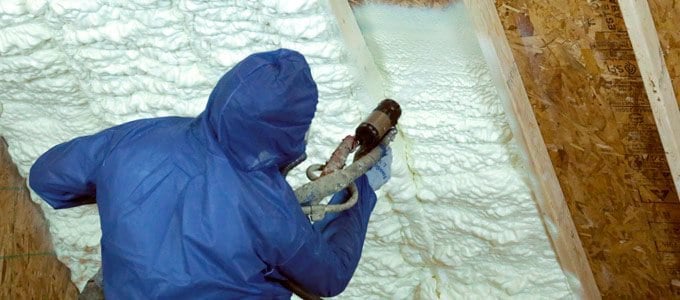
The next day of the project, a crew will come to your home and run a hose up to the work area in the attic. The majority of the second day is spent spraying the foam onto the roof deck or attic floor, depending on the job. A thin layer of foam is also sprayed on the roof studs to prevent thermal bridging.
Thermal bridging, also called a cold bridge or heat bridge, is an area of a building that has a significantly higher heat transfer than the surrounding materials, resulting in an overall reduction in thermal insulation of the building.
Thermal bridging is most commonly found in exterior wall studs, attics, and roof structures.
Once everything has been sprayed, the crew cleans up the area to look just like it did before the project started.
Which is More Efficient – Insulating the Floor or Roof Deck of the Attic?
The question we get most often is whether the homeowner should insulate the floor or the roof deck with spray foam.
We recommend insulating the roof deck with spray foam because we prefer the unvented system. It’s more efficient and, in our experience, safer in the long term.
The type of attic system you choose
ultimately depends on what you want to do with the space. If you want to make the attic usable for storage or living space and reduce the risk of moisture issues, the unvented system is the way to go.
A higher-pitched roof lends itself to a vented system and will still work to reduce air leakage in the home.
Let's dive a little deeper into what both of these techniques have to offer.
The first step to properly insulating an attic with spray foam is to seal off the building envelope by insulating the top of the house.
The most efficient attic insulation system is to spray open cell foam on the attic's roof deck. There are several reasons why this is more efficient:
- It stops outside air and moisture from entering through the roof.
- It protects your roof.
- It keeps your attic the same temperature as the rest of the house, so your furnace doesn't have to work as hard to maintain comfort.
- Heating the attic in homes with steeper roofs can help improve airflow throughout the home. Think of a lava lamp -- the warm air rises, cools, and sinks back down, just like the wax inside the lamp.
With a sealed roof deck, there's no need for traditional ventilation like ridge or soffit vents, but that doesn't mean air shouldn't move in the space.
In some homes, especially if the building envelope isn't completely sealed, adding mechanical air circulation (like an HVAC supply/return or a humidity-sensing fan) can help prevent humidity from building up in the attic.
Properly venting bathroom fans and stove hoods outdoors is also key to keeping moisture out of the attic.
Another insulation approach is to have spray foam applied to the attic floor, similar to a traditional system. This method requires working soffit vents with baffles and ridge vents to allow air to move in and out of the attic. The ventilation must be maintained, and the insulation must be installed and aligned correctly for this system to work. Because the performance depends entirely on continuous airflow, many contractors prefer the roof deck method for long-term efficiency and comfort.
How Much Money is Saved By Insulating the Attic?
You can definitely save money by insulating your attic with spray foam, but the amount you save can vary depending on your home.
Straight out of the gate, if your attic is the sole cause of your high energy bills, then the addition of spray foam in the attic could save you anywhere between 15 and 50 percent. If you have other insulation issues in the rest of your home, you won't see the same savings.
Here are a few other things that can affect your monthly energy bill savings.
Do you have a high-efficiency furnace or AC unit? If you answered no, your energy savings could be adversely affected because your dinosaur of an HVAC system is eating up all your energy.
What do you set your thermostat at? Do you change the settings when you're not going to be home or when you go to sleep? Just these little adjustments can help reduce your energy bills.
If you have insulation in the other areas of your home, then that can lead to air leakage in other areas, which in turn will lead to high monthly energy bills. We discuss this more below.
What Services Are Included When Insulating an Attic?
The best insulation companies should offer services that begin with an estimate call and end with a more comfortable home.
Some of the services that should be included are:
- A free estimate for the project.
- Free concierge program, so someone stays with you throughout the entire project to answer any questions you may have.
- Help with applying for project financing.
- Cleaning out old attic insulation and properly disposing of it.
- Clean up after the project is complete so your home looks just as it did before the project was started.
- Applying for rebates can get you money back for your project.
Added Protection Against Drafts and High Energy Bills
Sometimes, cold air moving through a crawl space or attic can contribute to the discomfort you feel in your home, but sometimes there is more to it.
Insulating your entire home using injection foam and spray foam can make a difference year-round, keeping you cool in the summer and warm in the winter and saving you money on your energy bills.
Fees and Taxes in Addition to the Attic Foam Insulation Cost
A good contractor won’t hit you with hidden fees and costs once the job is complete.
The estimate you sign and agree to should be the project's final cost.
Discovering Savings: Michigan Home Insulation Rebates
Michigan homeowners have an exciting opportunity to save on their energy bills by choosing foam insulation for their homes.
This program is part of a broader initiative to promote energy efficiency, and RetroFoam of Michigan is at the forefront, helping homeowners maximize their rebates.
Rebate Rewards: Unlocking Cash Incentives
If you're considering insulating a single area of your home, you can benefit from the standard mail-in insulation rebate.
Depending on your project's size, these rebates range from $50 to $250. Utility providers like Consumers Energy, DTE, SEMCO, and Michigan Gas and Utilities offer these rebates directly.
Additionally, homeowners who insulate at least two areas of their home can take advantage of the home performance rebate, which ranges from $400 to $1,100.
Eligibility and Assistance: Navigating the Requirements
It's crucial to understand that eligibility for these rebates requires consulting your energy provider to ensure your project qualifies.
RetroFoam of Michigan can be a valuable resource in this process. We are up to date on current insulation rebate amounts and help our customers understand these benefits.
Leveraging these home insulation rebates can significantly offset the cost of foam insulation for homes in 2026, reinforcing the financial advantages of this decision.
Getting Started with a Free Estimate
When you are ready to schedule a free in-home estimate, give us a call at 866-900-3626 or fill out the form on our website.
You can also use our budget calculator to get a rough estimate of your project cost.
If you'd prefer to continue your research on the benefits of foam insulation for your home, our Learning Center offers great resources.
Related Articles
Spray Foam Attic Floor or Rafters: Which is Best to Insulate?
What is the Best Insulation for an Attic? (Spray Foam vs Fiberglass vs Cellulose)
Open Cell or Closed Cell Spray Foam: Which is Best for the Attic and Roof?
Frequently Asked Questions About Attic Spray Foam Insulation
How much does it cost to spray foam an attic?
The cost to spray foam an attic typically falls between $5,900 to $12,000 for an existing home.
The final price depends on the attic size, the type of foam used, and the amount of insulation required to meet performance goals.
Why is spray foam more expensive than traditional insulation?
Spray foam costs more upfront because it provides both insulation and air sealing in one step.
Unlike fiberglass and cellulose, spray foam reduces air leakage, moisture intrusion, and thermal bridging, leading to better long-term energy savings and comfort.
Is open cell or closed cell spray foam better for attics?
Most attic projects use open cell foam because it's cost-effective and excellent at air sealing.
Closed cell spray foam may be used in certain situations where added moisture resistance or higher R-Value needed, but it comes at a higher cost.
Should the attic floor or roof deck be insulated?
Insulating the roof deck is typically the better option.
This creates an unvented attic system that keeps the attic at a similar temperature to the rest of the house, reduces moisture leaks, and improves overall energy efficiency.
Do I need to remove old insulation before spray foam is installed?
Yes.
Old insulation must be removed so the spray foam can properly adhere and perform as intended. Removing old material also helps identify air leaks, moisture issues, or roof deck concerns before installation.
How long does attic spray foam installation take?
Most attic spray foam projects take two days.
The first day is usually spent removing old insulation, and the second day focuses on spraying the foam and completing cleanup.
Will spray foam insulation help prevent ice dams?
Yes, when they are caused by heat loss in the home.
Ice dams often form due to heat escaping into the attic. Spray foam seals those air leaks, reducing heat loss and helping keep roof temperatures more consistent during winter.
How much can I save on energy bills after insulating my attic?
Homeowners may see energy savings of 15 to 50 percent, depending on how much energy loss was coming from the attic and whether other areas of the home are properly insulated.
Are rebates available for attic insulation?
Yes.
Michigan homeowners may qualify for utility rebates ranging from $50 to $1,100, depending on the scope of the project.
Is spray foam insulation safe for my home?
When installed by trained professionals using proper ventilation and curing procedures, spray foam insulation is safe and effective.
Once cured, it becomes an inert material that does not emit harmful gases.